
- What Is the TikTok Algorithm?
- How the TikTok Algorithm Works, Step by Step
- The Main Ranking Factors TikTok Uses in 2026
- 1. Watch Time and Completion Rate
- 2. Rewatches (Loops)
- 3. Shares and Saves
- 4. Comments
- 5. Captions, On-Screen Text, and Spoken Words
- 6. Video Information (Hashtags and Sounds)
- 7. Niche Relevance
- 8. Consistency and Posting Frequency
- 9. Engagement Velocity in the First Hour
- Why the TikTok Algorithm Has Changed So Much Going Into 2026
- How the TikTok Algorithm Compares to Instagram and YouTube
- How to Check Whether the Algorithm Is Favoring Your Content
- What the TikTok Algorithm Actively Avoids Recommending
- 9 Ways to Trigger the FYP Faster in 2026
- Common TikTok Algorithm Myths, Debunked
- Frequently Asked Questions
- Final Thoughts
If your videos are getting stuck at a few hundred views while someone else with a smaller account suddenly blows up overnight, it’s not luck. It’s the TikTok algorithm doing exactly what it was built to do.
The good news? The TikTok algorithm isn’t random, and it isn’t a secret formula only insiders understand. TikTok has explained a lot of it publicly, and the rest can be seen clearly in how videos actually perform. Once you understand what the system is really looking for, you can stop guessing and start creating content that the algorithm wants to push.
This guide breaks down how the TikTok algorithm works in 2026 in plain, simple language, and gives you a practical action plan to get your videos on the For You Page (FYP) faster.
What Is the TikTok Algorithm?
The TikTok algorithm is the recommendation system that decides which videos show up on a user’s For You Page, in search results, and across other parts of the app. Instead of showing people content mainly from accounts they follow, TikTok shows people content it predicts they will enjoy, regardless of who posted it or how many followers that account has. TikTok’s own Newsroom explanation of how the For You Page works confirms this directly.
This is why a brand-new account with zero followers can rack up a million views, while an account with 500,000 followers can post a video that only 2,000 people see. TikTok isn’t ranking accounts. It’s ranking individual videos, one at a time, based on how people respond to them.
How the TikTok Algorithm Works, Step by Step
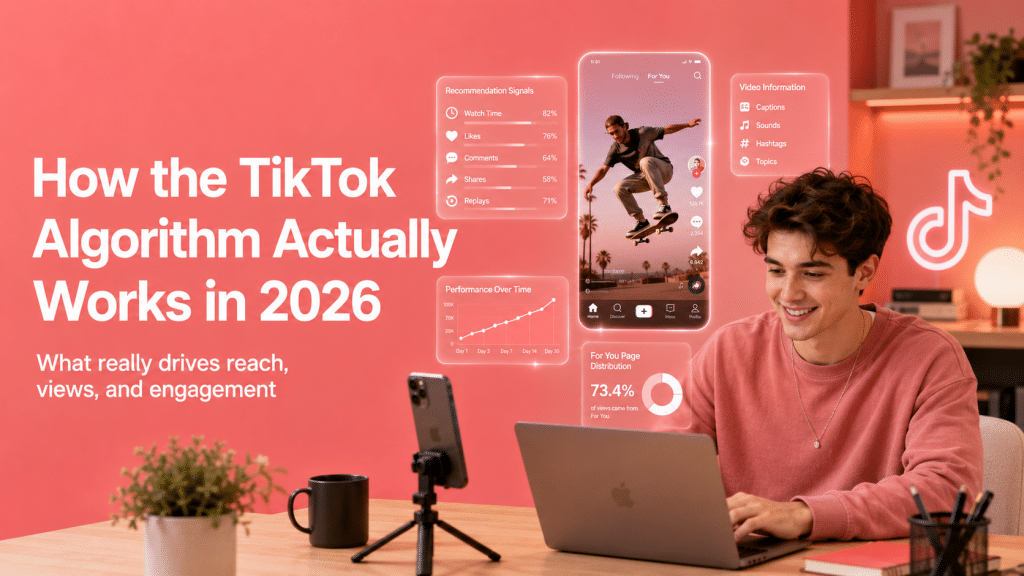
- You post a video. TikTok shows it to a small test audience first, often people who don’t even follow you.
- TikTok watches how that test group reacts. It tracks whether they watch the full video, rewatch it, comment, share, or scroll past in the first second.
- Based on that reaction, TikTok makes a decision. If the test audience responds well, the video moves into a larger pool of viewers. If it performs poorly, it stops there.
- The cycle repeats. Each round of viewers is bigger than the last, and the video keeps climbing as long as it keeps performing.
This is why your first few hours of views matter so much. TikTok is essentially running a live experiment on every single video you post.
The Main Ranking Factors TikTok Uses in 2026
1. Watch Time and Completion Rate
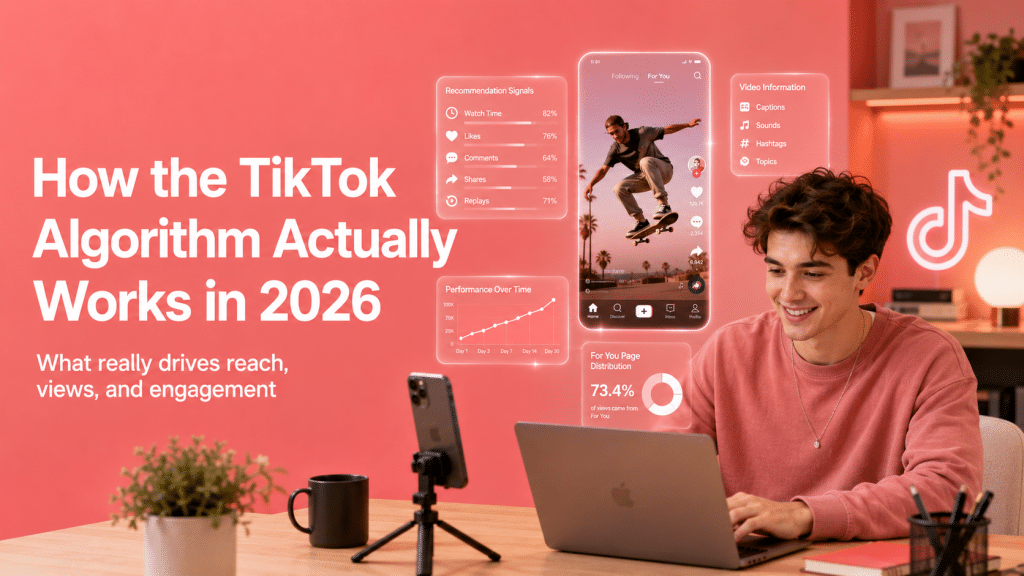
This is the single strongest signal in the tiktok algorithm. TikTok wants to know: did people watch this video all the way through, or did they scroll away after two seconds? Videos with high completion rates are treated as high-quality content and get pushed further.
2. Rewatches (Loops)
When someone watches your video, and then immediately watches it again, that’s one of the clearest signals you can send. It tells TikTok your content is valuable enough to experience more than once, and the tiktok algorithm rewards it heavily.
3. Shares and Saves
A share means someone liked your video enough to send it to a friend. A save means they want to come back to it later. Both signal genuine value and now carry more weight than likes.
4. Comments
It’s not just how many comments you get, but the quality of them. Longer, more thoughtful comments and active back-and-forth replies from the creator both boost a video’s standing.
5. Captions, On-Screen Text, and Spoken Words
TikTok now reads and indexes what you say in your video, what you type as on-screen text, and what’s written in your caption. This is essentially TikTok SEO: using the words your audience is actually searching for helps the tiktok algorithm understand your content and match it to the right viewers. If you’re building a broader growth plan across platforms, it’s worth browsing Viewsbuy’s Instagram growth tips as well, since the two platforms increasingly reward similar behavior.
6. Video Information (Hashtags and Sounds)
Hashtags and sounds still help TikTok categorize your content into the right communities, but they’re no longer a shortcut. A trending sound on a weak video won’t save it.
7. Niche Relevance
TikTok increasingly favors content that speaks clearly to a specific audience over content that tries to appeal to everyone. Going deep into a niche builds trust with the tiktok algorithm faster than chasing broad, generic topics.
8. Consistency and Posting Frequency
Posting regularly, ideally 3 to 5 times a week, gives TikTok more data to understand what your content is about. Posting daily doesn’t help if the quality drops, so consistency matters more than sheer volume.
9. Engagement Velocity in the First Hour
TikTok pays close attention to how fast a video accumulates likes, comments, shares, and watch time right after it’s posted. A video that picks up strong engagement within the first hour is treated very differently from one that trickles in slowly over a week, even if the total numbers eventually look similar. This is why the very first wave of viewers matters so much: their reaction essentially tells the tiktok algorithm whether it’s worth testing your video with a bigger audience straight away, or letting it fade quietly.
Why the TikTok Algorithm Has Changed So Much Going Into 2026
If TikTok feels different this year, you’re not imagining it. A few real shifts explain most of the confusion:
- Longer videos are getting more distribution. While short clips still perform well, TikTok has been pushing videos in the 1 to 3 minute range, rewarding creators who can hold attention at greater length rather than just in quick bursts.
- TikTok Shop signals now influence reach. Commerce-tagged content can appear in dedicated shopping feeds and may receive extra distribution, which matters for any brand or creator with product links.
- Search is a bigger discovery channel than ever. A large share of TikTok activity now starts as a search rather than passive scrolling, which is exactly why keyword-optimized captions and on-screen text carry so much weight in how the TikTok algorithm ranks content today.
- Ownership and infrastructure changes are reshaping the US algorithm. Behind-the-scenes changes to how the platform is run in some regions mean the system is being retrained on fresh data, so don’t panic over short-term dips. The core fundamentals below still apply regardless of these changes.
The takeaway is simple: chase the fundamentals, not the headlines. Watch time, completion rate, and genuine engagement will carry your content through any backend changes TikTok makes.
How the TikTok Algorithm Compares to Instagram and YouTube
It’s tempting to treat every platform’s recommendation system the same way, but the TikTok algorithm works quite differently from its biggest competitors, and understanding the contrast helps you avoid wasting effort in the wrong place.
Instagram was originally built around a social graph, meaning it leaned heavily on showing you content from accounts you already follow. TikTok, by contrast, runs almost entirely on an interest graph: it recommends videos based on what it predicts you’ll enjoy, regardless of whether you follow that account at all. This is the single biggest reason brand-new TikTok accounts can outperform established ones so quickly.
YouTube sits somewhere in between. Its recommendation system rewards long-term watch history and session duration across a video library, which favors channels with a large back catalog. TikTok’s algorithm, on the other hand, evaluates almost every video fresh, on its own individual merits, which is exactly why consistency matters more than accumulated authority.
The practical lesson: don’t assume a strategy that works on Instagram or YouTube will transfer directly to TikTok. Optimize each platform for how its algorithm actually behaves.
How to Check Whether the Algorithm Is Favoring Your Content
Rather than guessing, TikTok gives you the data to see exactly how your videos are performing inside its recommendation system. Open TikTok Studio or your Analytics tab and look at:
- Average watch time and completion rate — if this is consistently low across recent videos, that’s usually the first thing to fix.
- Traffic source breakdown — this shows how much of your reach came from the For You Page versus your existing followers, search, or your profile. A healthy FYP percentage means the tiktok algorithm is actively distributing your content to new people.
- Audience retention graph — look for the exact second viewers drop off. If most people leave at the same timestamp, that’s the part of your video to rework first.
- Shares and saves relative to views — a low view count with a high share-to-view ratio often means the content itself is strong, but it simply hasn’t reached its full test audience yet.
Checking these numbers after every few posts, rather than after every single one, gives you a clearer, less reactive picture of how the TikTok algorithm is actually treating your account.
What the TikTok Algorithm Actively Avoids Recommending
Knowing what hurts your reach is just as useful as knowing what helps it. TikTok is less likely to recommend:
- Low-effort reposts or heavily recycled content
- Videos with visible watermarks from other platforms
- Content that pushes viewers off the app
- Content that isn’t suitable for a general audience
- Anything that goes against TikTok’s Community Guidelines
If your reach has quietly dropped without explanation, checking your recent videos against this list is a good place to start.
9 Ways to Trigger the FYP Faster in 2026
- Hook viewers in the first 2-3 seconds. If you lose someone immediately, nothing else in the video matters to the tiktok algorithm.
- Write captions the way people actually search, not just hashtags. Think of your caption as a mini search-engine listing.
- Say your main keyword or topic out loud in the video. TikTok’s speech recognition picks this up and uses it for search ranking.
- Aim for a strong finish, not just a strong start. A satisfying payoff at the end encourages rewatches.
- Post when your specific audience is most active, not just at generic “best times to post.”
- Reply to early comments quickly. This increases session time on your post and signals genuine engagement.
- Stick to one clear niche instead of jumping between topics. This helps TikTok learn exactly who to show your content to.
- Use TikTok’s native editing tools where possible, rather than heavily branded third-party apps.
- Give your video every possible early advantage. Combined with the tips above, an initial push in genuine views, likes, and shares in that first testing window can help a video clear the early “test pool” stage and reach a wider audience. This is exactly where Viewsbuy’s TikTok growth packages (views, likes, followers, and shares) can complement solid content, giving new videos the early momentum needed to be taken seriously by the algorithm.
Common TikTok Algorithm Myths, Debunked
Myth: You need a huge following to go viral.
False. TikTok ranks videos, not accounts. A brand-new profile can outperform an account with hundreds of thousands of followers if the content performs well with its test audience.
Myth: Posting constantly guarantees more reach.
False. Quality and completion rate matter far more than volume. Several strong videos a week will consistently outperform daily low-effort posts.
Myth: Hashtags are the main way to get discovered.
False. Hashtags help TikTok categorize your video, but spoken words, on-screen text, and captions now carry equal or greater weight for discoverability.
Myth: Trending sounds guarantee views.
False. A trending sound can give a small boost, but it will not rescue a video that fails to hold attention.
Frequently Asked Questions
How does the TikTok algorithm decide what to show me?
It predicts what you’re likely to watch and enjoy based on your past behavior, such as videos you’ve completed, liked, shared, or rewatched, then continuously adjusts as your interests change.
Why did my TikTok views suddenly drop?
This usually happens when recent videos have lower completion rates, use recycled or watermarked content, or when the algorithm is testing your new content with a different, less-matched audience.
How many followers do you need to go viral on TikTok?
None. TikTok can show your video to millions of people who have never followed you, as long as it performs well during the initial testing phase.
Does deleting and reposting a video help it perform better?
Not usually. It’s generally more effective to improve future content based on what worked, rather than repost videos that already underperformed.
Is TikTok SEO the same as Google SEO?
No. TikTok ranks based on fast engagement signals like watch time and shares within the first 24 hours, while Google ranks based on long-term factors like backlinks and page authority. Both, however, reward relevant keywords and clear, useful content.
How long does it take for the TikTok algorithm to start pushing a new video?
Usually within minutes to a few hours. TikTok tests most videos against a small audience almost immediately after posting, then decides quickly whether to expand distribution based on that initial reaction.
Does using trending sounds still help in 2026?
It can give a modest early boost by helping TikTok categorize your content, but a trending sound will not rescue a weak video. Strong hooks and high completion rates matter far more than sound choice alone.
Can old videos suddenly go viral again on TikTok?
Yes. Because TikTok evaluates videos individually rather than by age, an older post can re-enter the testing cycle and gain fresh traction if it starts getting renewed engagement, such as a new wave of comments or shares.
Final Thoughts
The TikTok algorithm in 2026 isn’t working against you, it’s simply rewarding the behavior that keeps people watching, rewatching, and sharing. Focus on a strong hook, a clear niche, natural keyword-rich captions, and a satisfying payoff, and you’re already doing what the system is built to reward.
If you want extra support getting new videos past that critical early testing phase, Viewsbuy offers real engagement tools designed to work alongside strong content, not replace it.